
Lighting Production for Live Music Shows

Updated: Sep 8
The band is booked, the audience is expected, and the lighting rider arrives asking for moving heads, haze and a followspot. At a small UK venue, lighting production is not mainly a contest to specify the most impressive fixtures. It is the disciplined work of turning a creative request into a safe, programmable and repeatable show.
That matters at The Northcourt LIVE in Abingdon, Oxfordshire, a primarily standing venue with a capacity of 200. A lighting setup has to support tribute productions and original artists without overwhelming the room or slowing the day. The best result is rarely the largest inventory. It is the system that arrives prepared, suits the scale of the space and gives the operator enough control to make the performance look intentional.
Defining Lighting Production for Small Venues
A tribute act may arrive wanting the room to feel like a major concert. Its references may call for a familiar visual style, while the venue and schedule still require a practical approach. Lighting production turns that ambition into workable decisions about fixture positions, rigging, power, data, focusing, programming and operation. Each choice has to fit the show, the room and the available crew.
Lighting production starts before the van arrives. It covers the first conversation with the artist, rider checks, review of the venue's published information, agreement on supplier responsibilities, plot preparation, desk programming, show operation and the equipment strike. It also covers the details that regularly cause delays, including who supplies clamps, safety bonds, cable protection, haze fluid and the operator.
Integrated planning matters because lighting cannot be separated from rigging, power or crew workflow. A fixture may look right on paper and still fail if there is no suitable plan for hanging it, powering it, controlling it or focusing it in time.
Practical rule: A fixture is not useful until somebody knows where it will go, how it will be powered, how it will be controlled and who will operate it.
At The Northcourt LIVE, planning should reflect the actual room and the practicalities of a live music show, not an imagined arena production. The Northcourt LIVE Venue Guide provides venue information for planning the audience environment and practical visit. For technical planning, always use the current published information and confirm any show-specific details directly with the relevant provider or organiser before finalising a rig.
The output that matters
Good small-venue lighting provides coverage, contrast and control. Performers need clear visibility from the audience, the stage needs separation from its background, and the operator needs enough flexibility to follow the music without filling the room with visual noise.
A tribute show may require carefully timed recreations of recognisable moments. An original band may need a smaller group of adaptable looks that respond to the performance. Both depend on reliable equipment, sensible cable runs and a plan that can absorb a late change without forcing a full rebuild.
Setting Creative Goals for Tribute and Original Artist Shows
A small venue can sound clear yet look flat if the brief stays at “make it epic”. Set the visual job before choosing fixtures. Decide whether the show needs strong front light, saturated backlight, moving beams, timed blackouts or a busking layout. Those choices affect the rig, control approach, crew time and power plan.
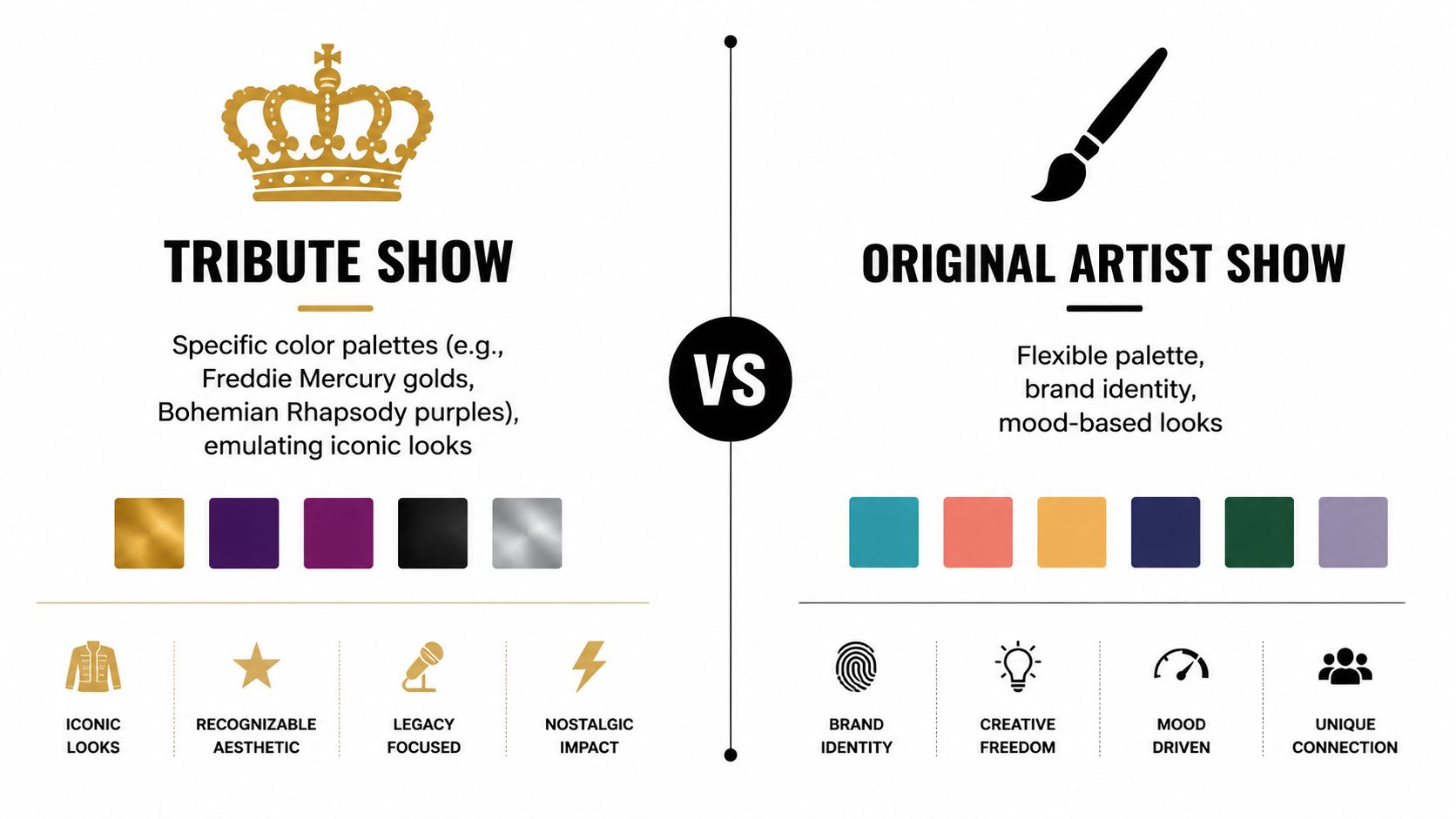
Tribute and original shows need different preparation. A tribute production depends on recognisable visual punctuation, such as a signature colour change, silhouette or transition. An original artist usually needs a flexible visual language that supports the music without forcing every song into a fixed recreation.
Begin with the right questions
Ask the act or tour contact:
What exists already? Request the lighting rider, plot, reference videos and any show files that can legally and practically be used.
What are the timeline and rehearsal limits? Establish the available programming time, soundcheck access and changeover window before committing to detailed cues.
Which moments matter most? For a tribute show, identify the opener, closer, instrumental feature or key transition rather than reproducing every detail.
How much can change on the day? A fixed design needs programming time. A busked show needs a clear selection of looks and accessible control groups.
For a Queen tribute, the brief might call for warm colour palettes, strong silhouette work and dramatic transitions around signature songs. Instead of copying a large touring production fixture for fixture, identify the visual cues that make the presentation coherent in a smaller room. Then check whether the agreed equipment, schedule and crew can deliver those cues without an unnecessarily complicated rebuild.
An original indie band might ask for a moody wash, restrained movement and gradual colour changes. Build a useful base look, a more intense chorus look, a darker atmospheric option and a clean speaking look. The operator can move between those states without programming an inflexible cue for every bar of music.
Define the show in layers
Separate the brief into must-have moments, repeatable looks and optional effects. Give programming time to the must-have moments. Repeatable looks keep the show manageable during a fast changeover. Optional effects stay in the plan only when they preserve safety, visibility and reliability.
This structure also gives the crew a practical fallback. If setup time, access or other practical conditions change, remove optional effects first while protecting the looks that carry the show. A short, tested cue set is more useful than a crowded show file that nobody can operate confidently from the desk.
Choosing Equipment That Works Within Venue Constraints
Every fixture is a compromise between output, colour quality, weight, power consumption, data requirements and setup time. The correct choice depends on the room and the show, not on whether a product looks impressive in a supplier catalogue.
An LED-heavy rig usually simplifies power distribution and reduces the need for external dimming. Traditional tungsten fixtures can still provide a familiar front-light quality, but they produce heat, draw more power and may require dedicated dimming arrangements. Moving heads add movement and beam options, yet they also bring weight, addressing, focus and maintenance considerations.
A useful equipment comparison looks like this:
Fixture type | Typical power draw | Setup complexity | Best use case |
|---|---|---|---|
LED wash or PAR | Low to moderate, depending on model | Low to moderate | General colour wash and compact stage coverage |
Traditional PAR can | High compared with LED alternatives | Moderate | Warm fixed looks where suitable dimming and power arrangements exist |
LED moving head | Moderate, with added data and rigging needs | Moderate to high | Dynamic movement, texture and selected feature moments |
LED bar | Low to moderate | Low to moderate | Backlight, vertical colour and stage depth |
Haze machine | Low to moderate, with venue controls to consider | Moderate | Revealing beams and adding texture where permitted |
The table deliberately uses qualitative power categories. Fixture consumption varies by model, operating mode and manufacturer specification, so the production manager should use the actual data sheet rather than rely on a generic assumption.
Spend power where the audience sees it
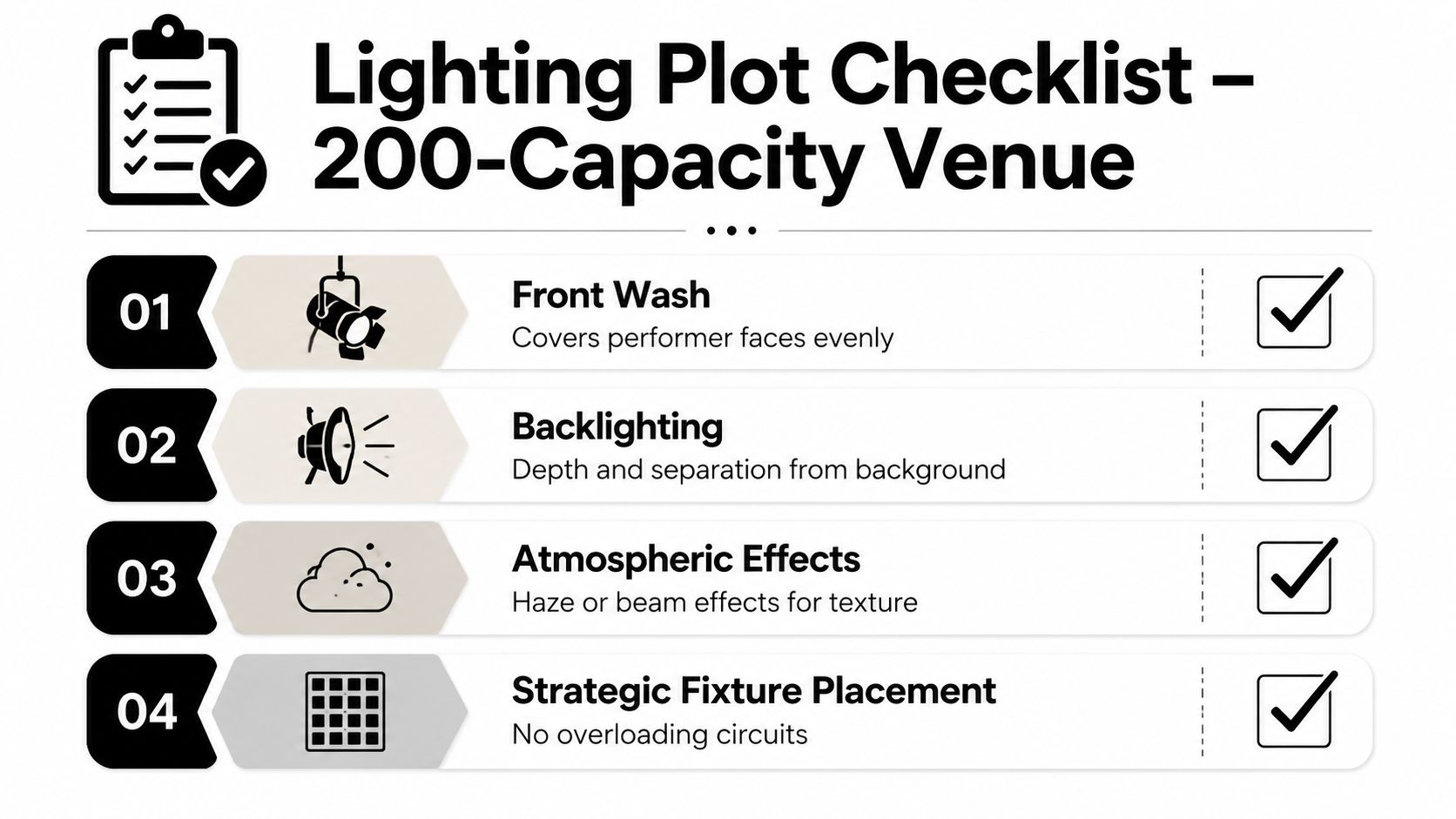
Front light earns its place because faces and instruments need readable coverage. Backlight creates separation and depth. Floor fixtures can add shape to a compact stage, but they need careful placement so they do not blind performers or audience members. Moving heads are most valuable when their movement has a musical purpose, not when they sweep continuously.
Power planning starts with the complete rig. Add fixture loads, haze equipment, control equipment and any associated production demand. Then confirm the supply arrangement, protection, distribution and cable routes with the relevant technical provider before show day. Domestic sockets should never be treated as a casual substitute for a proper production power plan.
For relevant venue details and current published information, use The Northcourt LIVE technical specification before confirming equipment.
Building Lighting Plots and Cue Sheets That Deliver
A small-venue plot should make the stage easy to cover and the rig straightforward to build. Begin with the available hang points, access routes, power arrangements and positions that can be reached safely for focus. A full bar is rarely better just because spare fixtures are available. Every added unit brings more cabling, addressing, focusing and potential faults for the crew to handle.
Give each position a clear job. A front position can provide even face light. An overhead position adds colour and shape. Rear or side fixtures separate performers from the background. Floor units can create silhouettes and low-angle texture, provided they do not obstruct the working stage or introduce a trip and access hazard.
Build the paperwork before the kit
A practical plot should show:
Fixture position and purpose. Label each unit by location and function, rather than by type alone.
Power and data routes. Record the circuit and DMX path so the crew can isolate faults quickly.
Addressing and mode. List the DMX address, fixture mode and channel footprint.
Focus notes. Mark the intended performer, instrument or stage area for each unit.
Safety information. Note hanging points, clamps, bonds and any access requirements.
Keep the hookup sheet usable at the stage edge. If a fixture goes dark, the operator should be able to check its power circuit, data address and desk channel without tracing an undocumented cable through a crowded stage. Clear paperwork reduces setup time and makes handovers less dependent on one person's memory.
Program for the way the show will be operated
A tribute cue sheet can use song titles, musical sections and specific visual events. Keep descriptions plain, such as “warm full stage”, “blue rear silhouette” or “guitar feature”. Another operator should understand the intention without decoding personal shorthand.
An original act may need fewer fixed cues and more busking controls. Group fixtures by function, keep intensity and colour changes accessible, and prepare several dependable base looks. The operator can respond to tempo, dynamics and stage movement while retaining a consistent visual identity.
UK live-production guidance emphasises that the rig must be installed and safe, focusing and plots must meet performance requirements, console channels and settings must be balanced as specified, and equipment must be powered in the required order and in good time. These checks are set out in UK guidance for live production lighting. A cue sheet should function as both an operational and creative document, allowing the operator to execute the show while preserving the designer's intent.
Managing Timelines Crew and Safety Requirements
At a small UK venue, a lighting day can lose time before the first cue is programmed. A late load-in or restricted access affects rigging, crew hours and the soundcheck together. Build the schedule around the actual plot, access window, available hands and agreed production plan, rather than a standard allowance.
Confirm hanging positions first, then sign off the rigging, followed by cabling and addressing, focus and programming, and finally the combined sound-and-light check. For a demanding tribute production, allow time for each stage. Original acts may need less fixed programming, but the same order still protects the show from rushed checks and avoidable rework.
Make the workflow visible
A practical production schedule should show:
Rigging and access: Assemble the structure, hang fixtures and fit safety bonds before focusing. Record any access equipment or restrictions that affect the work.
Cabling and addressing: Run protected power and data, label both ends and verify every fixture at the desk. Keep the route clear of public traffic and stage movement.
Focus and programming: Aim the units, set colour and beam positions, then build the required cues or busking looks.
Rehearsal and checks: Walk through transitions with the band and confirm that lighting, sound, staging and haze arrangements work together.
Name the responsible person for each task. One crew member may lead the lighting design and rigging while another operates the console. Both need the same plot, channel information and cue language. Add another technician when the rig is heavier, several acts share the bill or access makes carrying and positioning slow. Cutting crew can save a line on the quote while extending the day and leaving less time for testing.
Safety is part of the design
Every flown fixture needs suitable secondary retention. Rigging points must match the load, access equipment must be used correctly, and cable routes in public areas need protection against trips and damage. Haze requires agreement with the venue, performers and whoever manages alarms or ventilation.
Electrical safety deserves attention during design, not only during the final check. The Health and Safety Executive guidance for places of entertainment covers dutyholders organising events, venues and production crews. If the planned load exceeds the available supply, revise the design or involve a suitably qualified electrician. Do not solve distribution problems by casually daisy-chaining sockets.
Why Integrated Production Beats Standalone Lighting Procurement
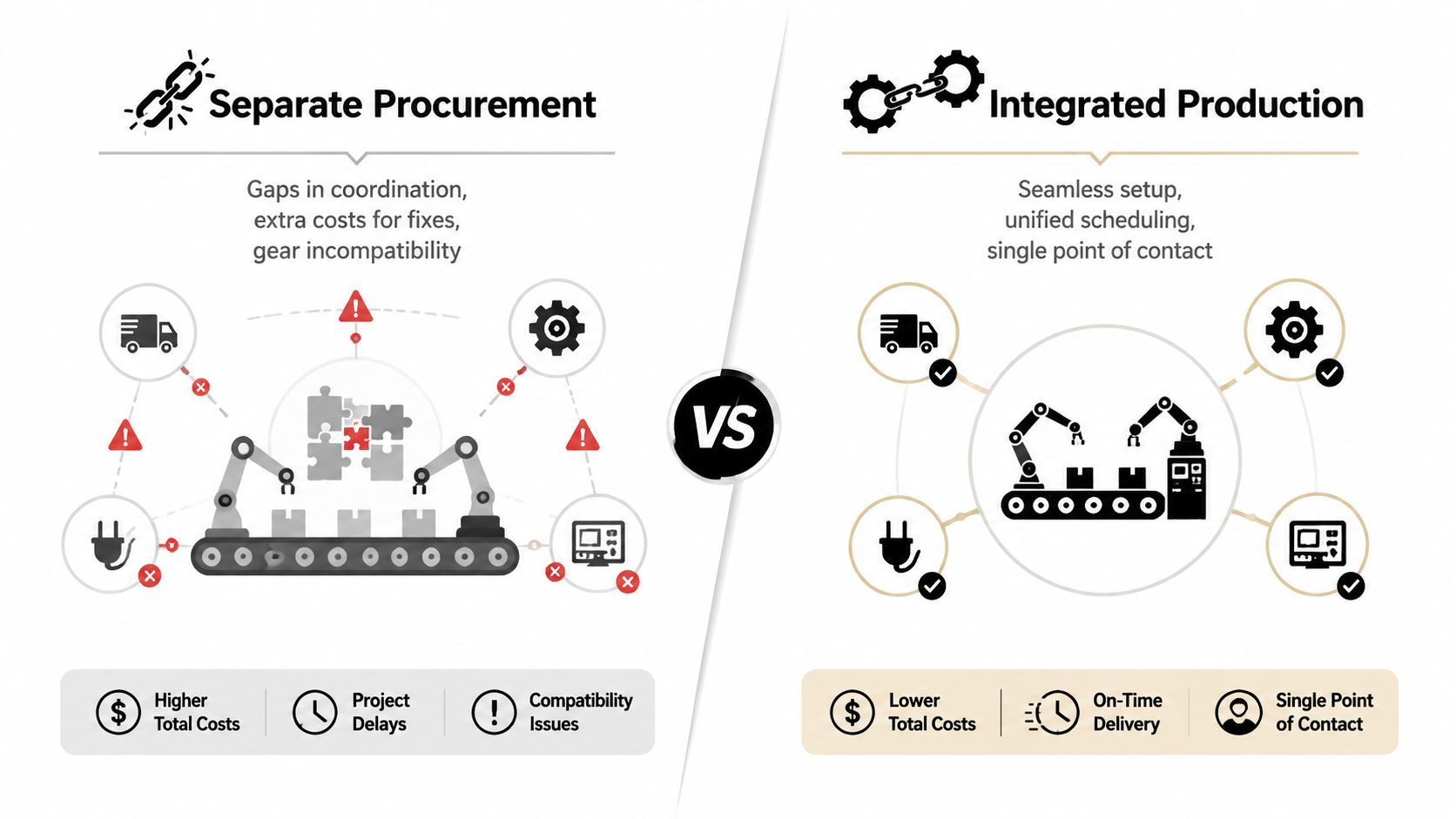
Buying lighting as a separate line item can look tidy until the gaps appear. The lighting supplier may arrive with fixtures that do not match the agreed plan, the data arrangement may conflict with another system, or the crew schedule may assume access that the venue cannot provide.
Integrated production planning gives the people involved a clearer view of the relationship between lighting, sound, staging, rigging and crew. That does not mean every show needs a large production package. It means the people making decisions should share the same schedule, technical information and definition of success.
A single delivery plan can prevent duplicated transport, incompatible control arrangements and last-minute substitutions. It also gives the production team a clearer response when set times move, an artist changes a requirement or a fixture becomes unavailable. The question is not whether a light can be hired cheaply. It is whether the entire show can be loaded in, operated and struck without creating a more expensive problem elsewhere.
For promoters and audiences around Abingdon, Oxford and wider Oxfordshire, the practical priority is professionally presented live music that suits the room and the audience. At The Northcourt LIVE, tribute bands, tribute shows and original artists all benefit from professional sound and lighting that matches the scale of the event. Paul Robins Promotions promotes its own live music events at the venue and works with professional sound and lighting providers as part of presenting those shows. For upcoming events, check out our upcoming line-up at The Northcourt LIVE ticket page.
For live music events promoted by Paul Robins Promotions at The Northcourt LIVE, Paul Robins Promotions provides the official event information and online ticket route. Visit Paul Robins Promotions to see the current programme of professionally presented live music in Abingdon, Oxfordshire.
Live photography: Alienation Photography — used with permission.
